With little fanfare, it appears that Manitoba is the newest province in Canada to enact personal information protection legislation that governs the private sector. Read more »
Author:
emp
10 4th, 2013 in
News
Comments Off on Manitoba Enacts New Privacy Legislation
I had previously written on the subject of electronic health records here, as well as about their governance here. The latter post was about the state of EHR governance in Ontario, especially when one considers legislative developments in Alberta and BC. It seems that the current Liberal government has decided to address the issue with the introduction of Bill 78, the Electronic Personal Health Information Protection Act 2013. Read more »
As we mark the technical end of summer, I can’t help but think that we’ve already seen the privacy case of the year. Granted we still have another three months left in 2013 but R. v. Telus has a lot going for it – especially in this increasingly “mobile” world.
Read more »
Author:
emp
09 19th, 2013 in
Privacy
Comments Off on The Privacy Case of the Year?
I never thought I’d ever mention Kim Kardashian in a blog post but, surprisingly, I find myself doing so in the context of a privacy breach. The “human element” in privacy violations – whether by error or omission in conduct or a willful or deliberate act – plagues organizations subject to breach notification requirements. Leaving aside compliance costs, conduct that might have met disciplinary action only ten years ago now is increasingly seen as totally unacceptable. But are employees really getting the message yet? And should employers be more explicit in getting that message out. Read more »
The last month has seen an uptick in privacy cases worthy of consideration. The latest that I’ve gotten around to perusing is Communications, Energy and Paperworkers Union of Canada, Local 30 v. Irving Pulp & Paper Ltd released by the Supreme Court of Canada in June. I think the case is more about arbitral precedents than privacy but the privacy aspect is far from trivial. Read more »
Author:
emp
07 15th, 2013 in
Privacy
Comments Off on Employee Privacy & Safety: The Latest
 Since the FACTA posts on this blog have generated a lot of traffic, I thought I’d pass along some information from my good friend Peter McLaughlin in Morrison Foerster’s New York office. It appears the IRS have decided to shift the implementation date for FATCA from 31 December 2013 to 1 July 2014. Not a very happy Canada Day for those Canadians with dual citizenship.
Financial institutions have until 25 April 2014 to finalize their registration. Full details can be read here. Still no word as to what will be in the intergovernmental agreement between Canada and the United States.
Author:
emp
07 15th, 2013 in
News,
Privacy
Comments Off on FATCA Delayed
Readers may recall my post on the subject of R. v. Cole here, a Supreme Court of Canada decision about expectations of privacy in workplace laptops. That decision has been now followed in a recent BC decision and while the facts are not terribly different, it is interesting to see the further application of privacy law and follow its evolution. Especially in light of an assertion made at the trial level. Read more »
Author:
emp
07 8th, 2013 in
Privacy
Comments Off on Deletion of Computer Files Not Abandonment of Privacy Interest
Back in 1997, Apple had an enormously successful ad campaign with the signature phrase “think different”. You can see it here. A recent British Columbia decision illustrates the fact that Canada’s provinces do “think different” from time to time with respect to the shape of the common law, in this instance with respect to a common law tort concerning privacy. I’m not sure this BC decision is as negative a result as some might initially think although it does highlight the fact that we have conflicting views at the provincial level. Read more »
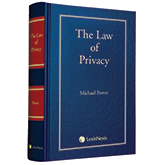 For those who may be interested, that book I kept rambling on about (and which took me away from blogging) has now been published. The Law of Privacy is available through Lexis Nexis. I’m most grateful to David Loukidelis, the former Privacy Commissioner of British Columbia, who was kind enough to write the forward.
Author:
emp
06 24th, 2013 in
Notice
Comments Off on The Book Is Out
I recently came across a calculator while reading a Financial Times article (registration required) on the surveillance of consumers. It shows just how much marketers value our personal data – apparently it’s just pennies and we don’t even have those in Canada anymore. This 2010 Forbes article talks about the monetization of personal data and even refers back to the last century (well, 1999) as to early efforts to do so. The European Commission even had a study done on the subject of pricing models for personal data privacy which you can find here. We’re also starting to see courts awards, which gives a rough valuation as to damages. Given these different aspects, people are increasingly interested in asking what’s privacy worth.
Read more »